Complete Guide to AI Server After-Sales Service, Part 2: Three Supply Models, Very Different Responsibility Attribution
Published: Updated:
The previous article used the L1–L12 grading to discuss after-sales needs at four levels: components, boards, complete systems, and racks. But when something goes wrong with a piece of equipment, who bears responsibility often depends not on which level the failed part sits at, but on "who assembled it and who is accountable." Depending on how they are supplied, AI servers fall into roughly three types: complete systems defined and delivered by the original manufacturer, complete systems assembled by a server vendor from core modules, and modular systems built on an open architecture that can be flexibly configured. For business owners, the supply model chosen at purchase also determines who to turn to when problems arise, how repairs are handled, and how responsibility is allocated. This article explains, in turn, the responsibility allocation and after-sales needs of each of the three models, and finally introduces how wareconn addresses them with a single platform. I. Original-Manufacturer Own Brand: A Single Point of Contact, Service Under the Manufacturer's Program An original-manufacturer own brand means the complete system is defined and delivered by the original manufacturer. DGX is an example: it is built around the HGX 8-GPU baseboard, but the complete system is designed and delivered by the original manufacturer itself [1][2]. For the customer, it is "all covered by the original manufacturer," with only one point of accountability. After-sales service needs center on interfacing with the original manufacturer: |
➤ Single point of contact, service under the manufacturer's program | ||||
Taking DGX as an example, according to the original manufacturer's enterprise support services datasheet published in 2020, it must be paired with the manufacturer's support services contract, which covers full-lifecycle hardware and software support, next-business-day Advanced RMA (advance replacement, depending on region), and support for the operating system, drivers, and firmware [3]. Responsibility determination is therefore centralized with the original manufacturer, and turnaround time and the repair or replacement method follow the manufacturer's program. Spare parts are likewise provided under a program: taking the 2018 DGX-1 as an example, the manufacturer's spare parts program covers specific parts such as power supplies, fans, and memory, and whether they are supplied is decided by each reseller or partner [4]. | ||||
➤ The repair submission process must match the manufacturer's | ||||
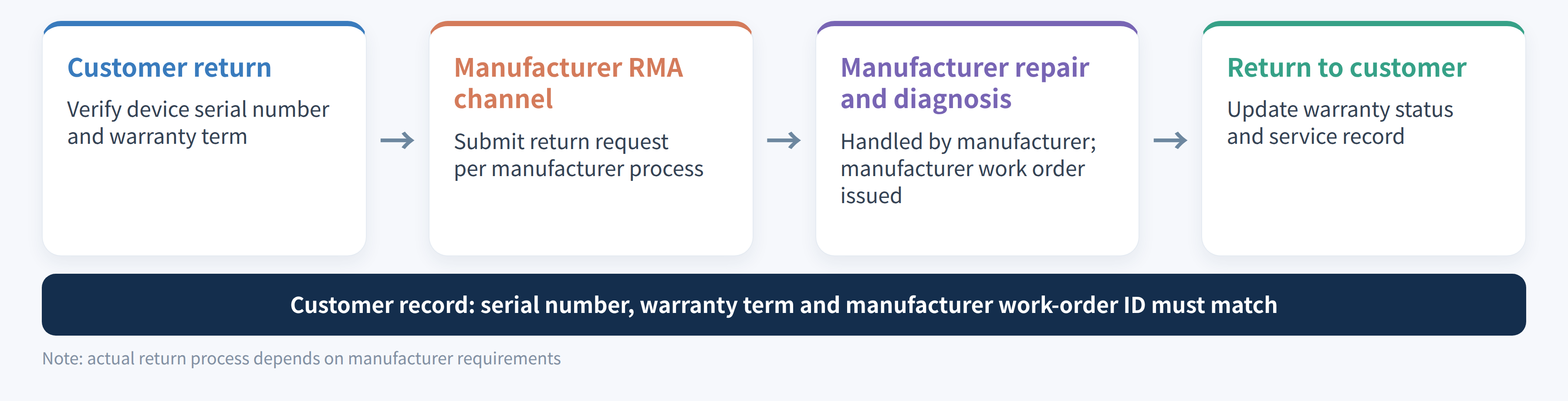
Equipment must be sent for repair through the process the original manufacturer specifies, and the customer's records must be consistent with the manufacturer's work orders. If an enterprise manages original-manufacturer systems alongside equipment from other brands, records are scattered in different places, and warranty periods and repair progress can easily fall out of sync. Replacement spare parts also carry their own warranty period: under the DGX-1 spare parts program, for example, if a spare part ships within the last 90 days of the support period, it receives 90 days of hardware support (if shipped earlier, coverage runs to the end of the support period) [4], and this must also be recorded item by item. | ||||
To address these needs, the approach is to standardize repair submission and record each unit's serial number, warranty period, and the manufacturer's work order number, so that repair submission, return, and warranty status are all traceable (see Figure 1). | ||||
Figure 1: Diagram of the original-manufacturer repair process and customer-side records |
II. OEM Integration: Three-Party Responsibility, Different SOPs OEM integration means the brand owner supplies the core modules, and the server vendor (OEM) selects the remaining parts and assembles the complete system. A server built on an HGX baseboard is one example: HGX is a GPU baseboard platform supplied to server vendors, containing the GPUs and high-speed interconnect modules, while the vendor selects the CPU, memory, storage, and chassis on its own [1][2]. The latest HGX is offered as a single baseboard with eight GPUs, which can be paired with an x86 or other-architecture CPU board [2]. The brand owner, the OEM, and the customer's usage environment mean that three parties are involved with a single piece of equipment. After-sales service needs center on responsibility determination and process differences: |
➤ Three-party responsibility: VID/PID determination is complex | ||||
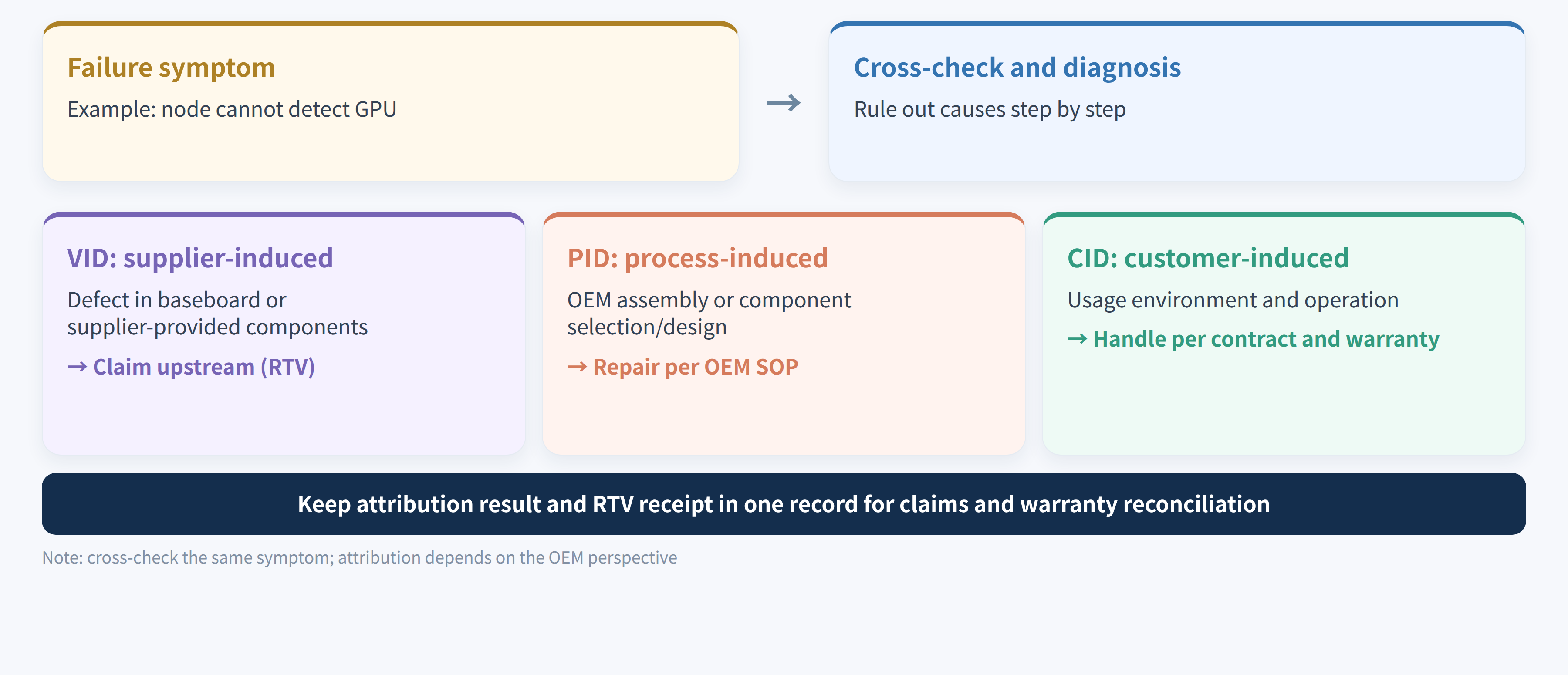
From the OEM's perspective, defects in the baseboard and parts themselves are supplier-caused (VID), improper assembly or component-selection design is process-caused (PID), and improper use is customer-caused (CID). Taking HGX as an example, the GPU portion has a topology fixed by the baseboard, while the other peripherals are designed by each vendor [1]. Troubleshooting must therefore first distinguish whether the problem lies with the baseboard or with the power, cooling, or assembly that the OEM chose; for example, if a node fails to detect the GPU after boot, cross-verification is needed before a conclusion can be reached. When attribution is unclear, recovery of costs and warranty claims easily lead to disputes. | ||||
➤ Each vendor has different SOPs | ||||
Even among OEM-integrated models, warranty terms and repair submission processes differ from one OEM to another. Taking publicly available terms as an example, one OEM's standard warranty for GPU systems is 3 years of labor, 1 year of parts, and 1 year of advance replacement shipping, and returns require an RMA number first [5]. Another OEM's public terms state that the limited hardware warranty period varies by product and may be 90 days, 1 to 5 years, or other terms, and longer service periods can be purchased separately as premium support services [6]. The labor and parts warranty periods for the same piece of equipment may also differ (such as the 3-year labor and 1-year parts of the OEM mentioned above), so warranty records must be able to be kept separately in order to determine whether a replacement part is still under warranty [5]. An enterprise purchasing from multiple OEMs cannot use a single process for all of them; otherwise, the repair submission method and turnaround time will not match the contract. | ||||
To address these needs, repair SOPs and warranty types must be established separately for each OEM brand, and the attribution determination results and RTV documents must be retained, so that baseboard or part problems can be traced back upstream and responsibility and quantities reconcile (see Figure 2). Repair submission data must also be prepared in advance: taking the OEM above as an example, an RMA number must be obtained first and marked on the outer box of the returned item [5]; if the product model, serial number, and fault description are already kept in the same record, they can be checked quickly at the time of repair submission. | ||||
Figure 2: Diagram of three-party responsibility determination for OEM-integrated models |
III. Modular, Flexible Supply: Diverse Configurations Are Hard to Manage Under a Single Standard Modular, flexible supply means a system vendor starts from an open base architecture and selects its own compute, networking, and storage modules. The MGX reference architecture is an example: GPUs, DPUs, and CPUs can be chosen freely to assemble more than 100 server variants, compatible with current and future generations of hardware [7]; the manufacturer's technical articles also use MGX to explain the design of rack systems [8]. After-sales service needs arise from the diversity of configurations: |
➤ Many SKUs, customized configurations | ||||
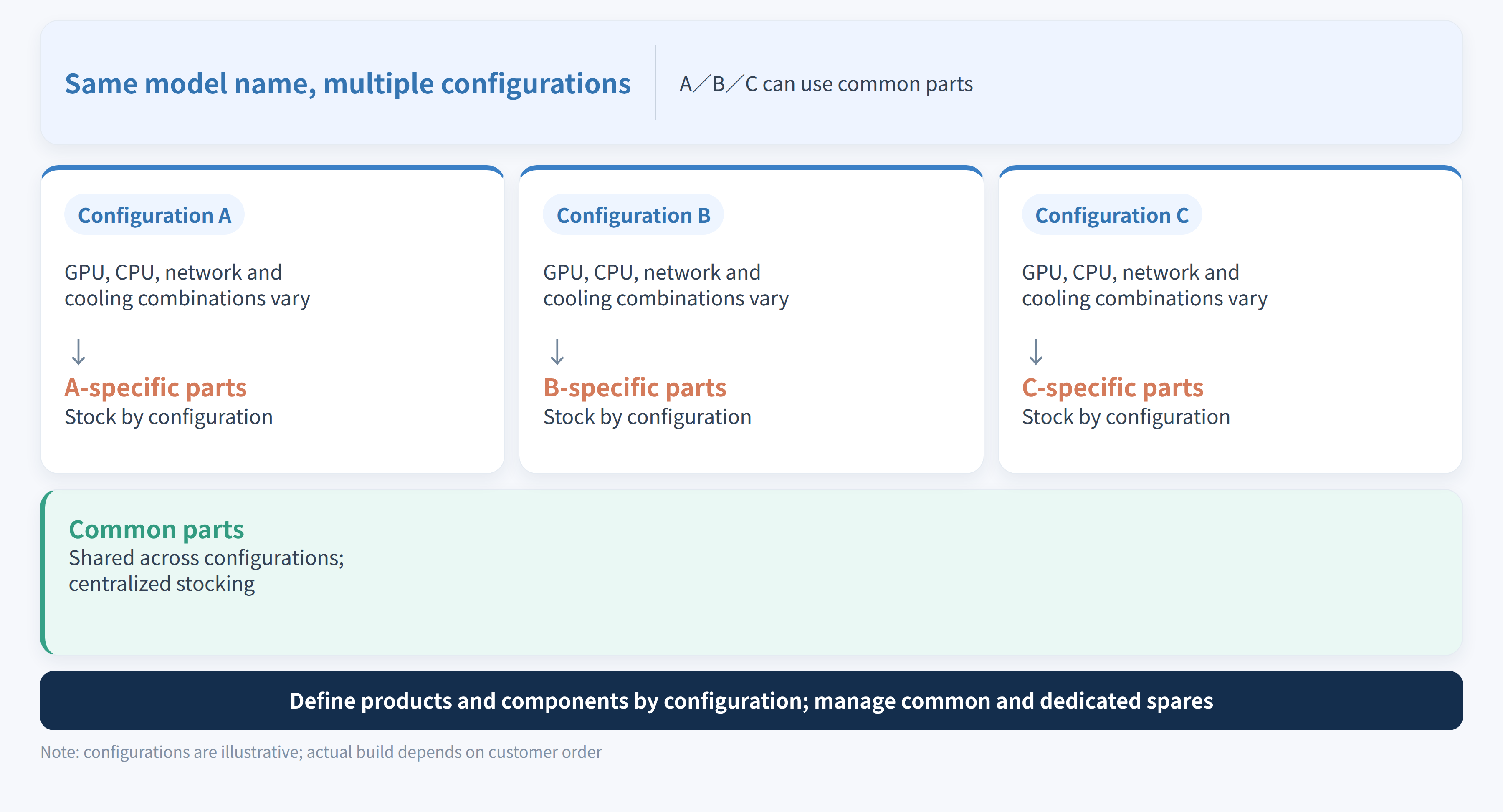
Under the same model name, the combinations of CPU, GPU, network card, and cooling can all differ; the original manufacturer explains that MGX supports hundreds of combinations of GPUs, DPUs, CPUs, storage, and networking [8]. If spare parts and repairs are managed by model number alone, it is easy to stock the wrong part or apply the wrong process, and it is also hard for customers to confirm exactly which configuration their equipment is. | ||||
➤ Mixed generations are hard to manage under a single standard | ||||
A modular architecture can be compatible with several generations of hardware, so equipment from different generations may coexist in the same data center, with differing firmware and compatibility requirements that a single repair standard can hardly cover. Taking the MGX rack as an example, the compute tray is composed of combinations such as CPUs and GPUs and includes cooling components such as liquid-cooling cold plates [8], so the retest conditions after a part replacement must also be adjusted to the configuration. | ||||
To address these needs, products and parts must be defined according to the actual configuration, and spare parts are managed in two categories, shared parts and dedicated parts: shared parts that are common across configurations are stocked centrally, while dedicated parts used only in specific configurations are stocked by configuration (see Figure 3). Research in inventory theory indicates that using shared parts under service-level constraints benefits inventory, but there is no universally applicable conclusion about how the inventory level of each individual part changes [9]. The stocking levels of both categories of spare parts therefore still need to be set item by item according to actual usage and cost. | ||||
Figure 3: Diagram of modular configuration and spare parts management |
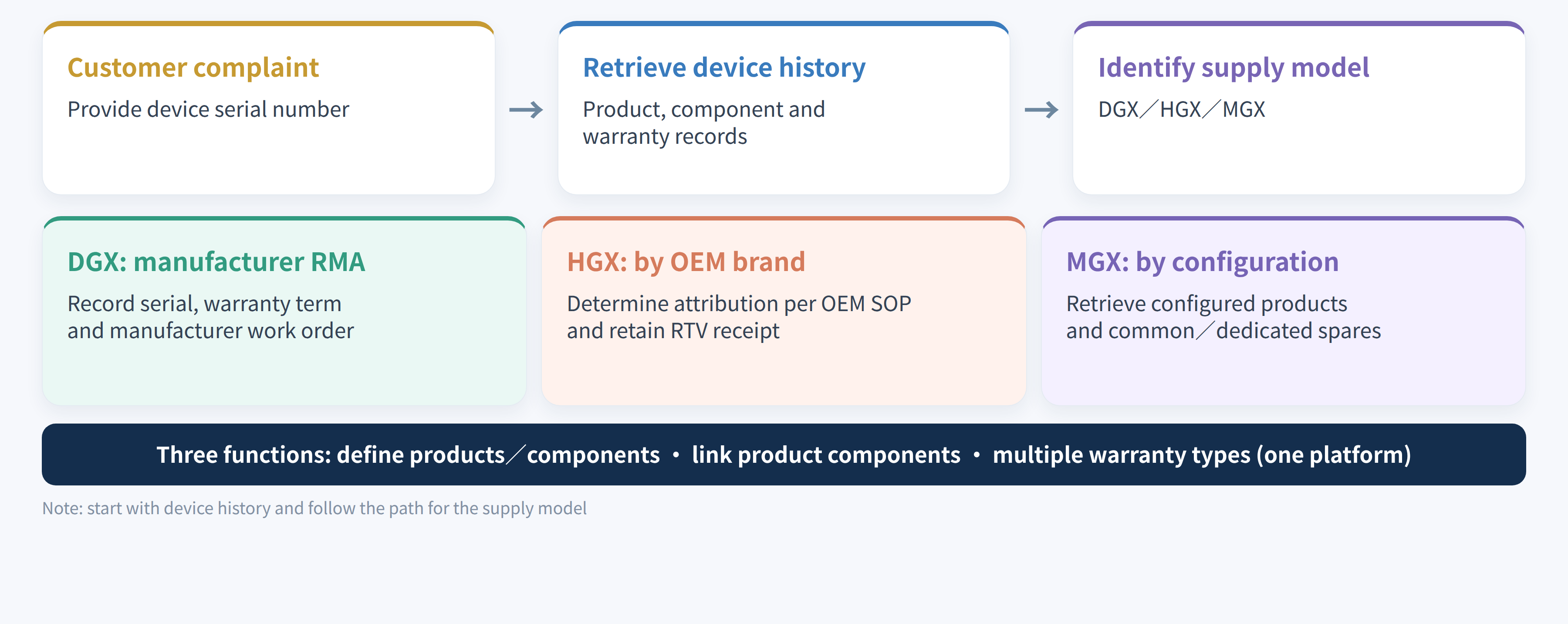
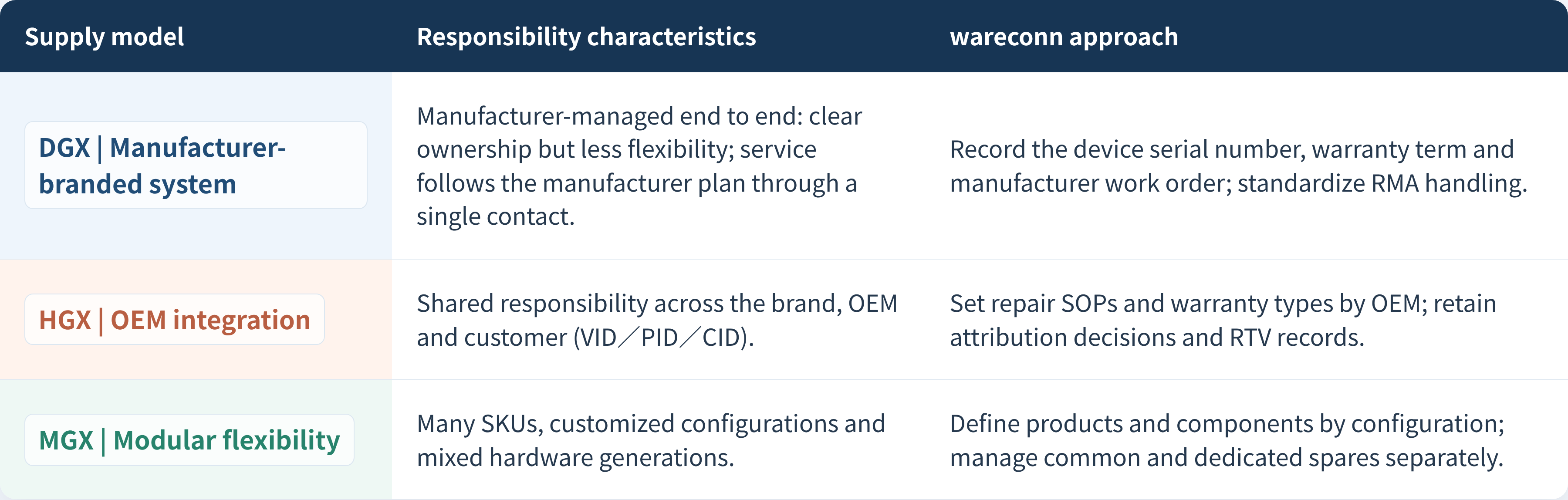
IV. How wareconn Addresses the Three Supply Models The three models differ in responsibility allocation and after-sales priorities (Table 1), yet share a common point in management: who supplied the equipment, who assembled it, which parts it consists of, and which warranty applies must all leave a traceable record. wareconn uses a unified platform to manage records and responsibility allocation across the supply chain, building on the three features from the previous article: "Define Product/Part," "Product-Part Association," and "Multiple Warranty Types." When a customer complaint comes in, the equipment's product, part, and warranty records are pulled up first to confirm which supply model it belongs to, and then the corresponding repair submission, determination, or spare parts path is followed (see Figure 4). |
Figure 4: Handling paths for the three supply models linked through the equipment history record | ||||
Table 1: Responsibility allocation of the three supply models and corresponding wareconn approaches | ||||
SLAs and spare parts strategies can also be set flexibly according to the supply model and customer needs, without having to build a separate system for each model. For example, original-manufacturer systems must be paired with the manufacturer's support services contract [3], and the contract term should also be retained together with the equipment serial number and warranty period. Once responsibility allocation and repair records are retained in a structured form, they can also serve as the basis for ongoing analysis and for improving warranty costs and product reliability [10]. |
Conclusion Only by looking at which supply model a piece of equipment belongs to can the correct responsibility allocation and repair path be applied: for original-manufacturer own brands, the focus is on interfacing with the manufacturer's repair submission and contracts; for OEM integration, on comparing each OEM's terms and determining attribution; and for modular, flexible supply, on managing spare parts by configuration. The previous article covered after-sales needs at each level, and this one covers responsibility allocation under each supply model; what the two have in common is that traceable data is needed for responsibility and repair paths to line up. |
Author
Wareconn Editorial Department

Complete Guide to AI Server After-Sales Service, Part 2: Three Supply Models, Very Different Responsibility Attribution.pdf
Reference
- AMAX, Manufacturing Level, AMAX Total Computing Solutions.
- Aly Pinder, 2022, Worldwide Manufacturing Product and Service Innovation 2023 Predictions, IDC FutureScape, IDC #US48627622.
- Wallace R. Blischke, M. Rezaul Karim, D. N. Prabhakar Murthy, 2011, Warranty Data Collection and Analysis, Springer.
- “Powering warranty reinvention: How electronics companies leverage new technologies to improve warranty management”, IBM Institute for Business Value, 2017.
- Albert Liao, 2022, Warranty Chain Management - Digitalization and Sustainability, Springer.
- Open Compute Project, Liquid Cooling Integration and Logistics White Paper, Revision 1.0 (CC BY-SA 4.0).
- NVIDIA, 2024, NVIDIA Contributes NVIDIA GB200 NVL72 Designs to Open Compute Project, NVIDIA Technical Blog.
- Hewlett Packard Enterprise, NVIDIA GB200 NVL72 by HPE QuickSpecs.
- Google Cloud, Proactive prevention: Inside Google Cloud's multi-layered GPU qualification process, Google Cloud Community.
- Crusoe, Burn-in validation, Crusoe Cloud Documentation.
Related articles

AI server deployments continue to scale up, and equipment form factors stack up layer by layer, from components and boards to complete systems and racks. IDC’s 2022 forecast noted that about half of products and assets were already connected (49. 6%), expected to rise to 67. 2% within three years[2].

The value of warranty data is often underestimated because companies tend to use it only to identify problems, without taking the next step to ask, “Why did it happen? ” Was it caused by a design defect, a manufacturing process issue, or the quality of a supplier component?

Service centers must simultaneously track four interlocking metrics every day — intake, output, WIP, and average TAT — that are all tightly interconnected: if intake volume consistently exceeds output volume, WIP will inevitably pile up quickly, which in turn drags down TAT.

In the previous article, we broke down the structural impact of Directive (EU) 2024/1799 on product scope, spare parts supply periods, warranty extension logic, and information disclosure obligations. This article turns to what companies actually need to do: as the rules take effect across the EU simultaneously from July 31, 2026, what sequence should companies follow to comply? What requirements does the European online platform for repair impose? What functions should be evaluated when assessing a repair management system? What advantages come from choosing the right tool? The article closes with how the wareconn platform can help companies navigate this transition.

The EU Right to Repair Directive (2024/1799) applies since 31 July 2026. See the repair duty, 12-month warranty extension and how to adapt after-sales.